Window Heat Loss: Curtains, Film, and Air-Sealing Calculator
Estimate winter window heat loss, compare curtains with interior film and air sealing, and use a moisture-aware checklist before buying replacement windows.
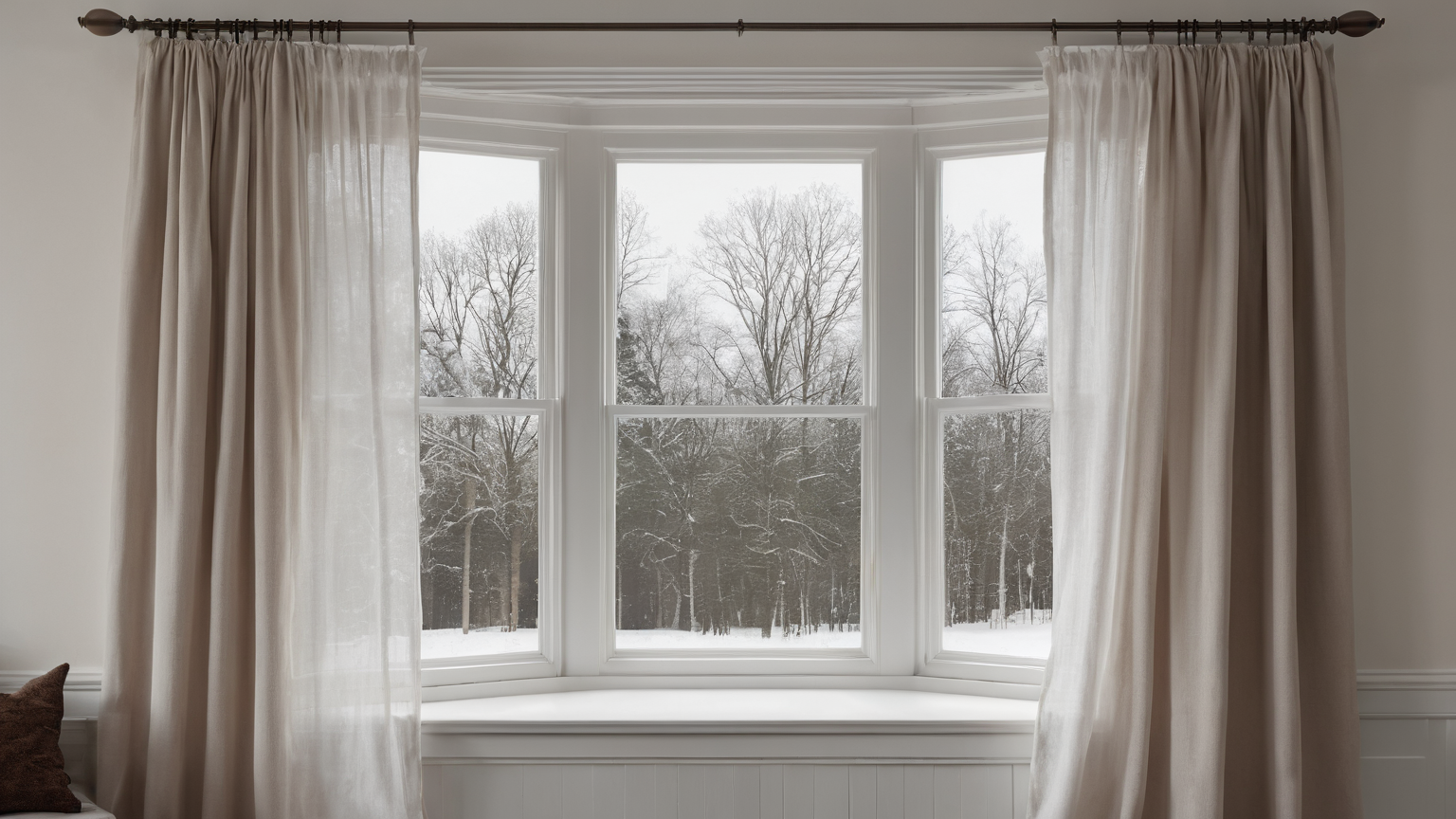
A cold window can lose heat in three different ways: conductive heat flow through the glass and frame, air leakage through moving joints or installation gaps, and radiant heat exchange that makes occupants feel chilly near the surface. Curtains, interior shrink film, and air sealing address different parts of that problem. Treating them as interchangeable products leads to disappointing savings and sometimes trapped moisture.
Start by diagnosing the pathway, then calculate an order-of-magnitude cost. The calculator below is transparent enough to edit with your own window area, climate, heating system, and utility rate. It is a planning screen, not a substitute for blower-door testing, a Manual J load calculation, manufacturer instructions, or an inspection of damaged windows.
First separate heat flow from drafts
A window can feel cold even when it is not leaking air. Indoor heat moves through the glazing and frame toward colder outdoor conditions. The window’s U-factor describes that rate: lower is better. ENERGY STAR’s window program uses climate-zone criteria and certified product ratings rather than treating every double-pane unit as equivalent (ENERGY STAR windows). The whole-product U-factor, not center-of-glass R-value, is the useful input for this calculator.
Air leakage is different. Wind and stack effect can pull cold outdoor air through sash joints, failed weatherstripping, pulley cavities, or gaps between the window unit and rough opening. PNNL’s Building America guidance warns that fibrous insulation in a rough-opening gap is not by itself an air barrier and describes closed-cell backer rod, sealant, and low-expansion window-and-door foam as appropriate materials for specific gaps (PNNL rough-opening guide).
Finally, a cold glass surface can draw radiant heat from your body. A snug curtain or shade can improve perceived comfort even when the room thermostat does not move. That comfort benefit is real, but it should not be converted into a guaranteed bill-savings percentage.
A window heat-loss calculator you can audit
For steady conductive heat loss, use:
Heat loss (Btu/h) = U-factor × window area (ft²) × temperature difference (°F)
Assume four windows total 60 ft², whole-window U-factor is 0.50 Btu/h·ft²·°F, indoors is 70°F, and outdoors averages 30°F during a 12-hour night.
Temperature difference = 70 − 30 = 40°F
Hourly loss = 0.50 × 60 × 40 = 1,200 Btu/h
Nightly heat = 1,200 × 12 = 14,400 Btu
Convert with 3,412 Btu per kWh:
Delivered heat = 14,400 ÷ 3,412 = 4.22 kWh-equivalent
The electricity your heating system uses depends on effective coefficient of performance, or COP:
- resistance heat at COP 1: 4.22 kWh;
- heat pump at effective COP 2.5: 4.22 ÷ 2.5 = 1.69 kWh.
At a hypothetical marginal rate of $0.18/kWh, the window’s estimated 12-hour conductive cost is $0.76 with resistance heat or $0.30 with the heat pump. Over 120 similar nights, that becomes about $91 or $36. This excludes air leakage, solar gain, frame-edge effects not represented by the input, changing weather, defrost, and heating-system cycling.
The space-heater versus heat-pump guide explains why delivered heat must be divided by effective COP before comparing electric costs.
Estimate an attachment without inventing savings
If a tested curtain, shade, panel, or film assembly provides a rated whole-window U-factor, rerun the same equation. Suppose an attachment reduces the effective U-factor in the example from 0.50 to 0.35 while correctly deployed:
New nightly loss = 0.35 × 60 × 40 × 12 = 10,080 Btu
Estimated reduction = 14,400 − 10,080 = 4,320 Btu, or 30% of the conductive portion
That is not automatically a 30% heating-bill reduction. The windows are only one part of the building load, and the attachment may be open during sunny hours, leaky at its edges, or used only in one room. The Attachments Energy Rating Council maintains a certified-product search and ratings framework for window attachments (AERC). Prefer tested, product-specific values over vague “energy saving” packaging.
If no rated value exists, do not assign a magical R-value. Use a range. Recalculate at U-factors of 0.45, 0.40, and 0.35, then label the results scenarios. Measure whole-home energy over comparable weather periods to learn whether the actual change is visible.
Curtains, film, and sealing compared
| Measure | Primary job | Best candidate | Main limitation | Reversible? |
|---|---|---|---|---|
| Close-fitting insulated curtain or cellular shade | Reduces conductive and radiant exchange while deployed | Sound window with uncomfortable cold surface | Gaps and open daytime position reduce effect; condensation may hide behind it | Yes |
| Interior shrink film across frame | Creates a still air layer and blocks leakage through operable window area | Drafty seasonal window that can remain closed | Restricts operation and access; tape may affect finishes | Usually |
| Sash weatherstripping | Limits leakage at a moving joint | Operable sash with worn or missing seal | Wrong thickness can prevent locking or drainage | Usually |
| Interior trim/rough-opening air sealing | Stops bypass around installed unit | Air movement at casing or documented installation gap | Trim removal and material choice require skill | Not easily |
| Replacement window | Replaces damaged or poor-performing whole unit | Rot, failed structure, irreparable hardware, or project-level upgrade | Highest cost and installation disruption | No |
ENERGY STAR presents sealing and insulation as a sequence: identify the problem, judge project effort, then complete suitable work or use qualified help (seal-and-insulate hub). That order prevents buying curtains for a wet wall cavity or replacing glass when the major leak is behind the trim.
When curtains work well
A curtain or shade performs best when it forms a contained air layer near the window. It should fit close to the sides and top and reach the sill or floor without covering a heater, radiator, return grille, or required control. Close it on cold nights; open it when useful winter sun can safely warm the room. Do not let fabric touch condensation or block an exit.
Curtains are especially useful when comfort near otherwise functional glass is the main complaint. They also preserve window operation better than seasonal film. Their weakness is edge leakage: a decorative panel hanging several inches from the wall with open top, bottom, and sides may offer privacy but limited thermal control.
Check behind closed coverings each morning during the first cold week. Moist indoor air can reach the glass and condense while the curtain keeps room heat away from it. EPA recommends controlling indoor moisture, fixing leaks, and generally keeping indoor relative humidity in a suitable range; its IAQ overview cites 30–50% as a broad target while recognizing conditions vary (EPA indoor-environment guidance). In very cold weather, even 30% may be too high for some windows.
When interior film is the stronger move
Clear heat-shrink film can create a sealed interior air space across the window frame and reduce noticeable drafts through the covered opening. ENERGY STAR calls interior plastic an easy, inexpensive option and provides project-fit, safety, preparation, and installation guidance (plastic-over-windows project). Follow the film and window manufacturers rather than improvising heat, tape, or attachment surfaces.
Film is best for a window that will remain closed for the season and is not needed for emergency egress, ventilation, or access. It is not a repair for cracked glass, rot, water intrusion, failed flashing, or a loose frame. It can also hide condensation. Inspect the cavity before installation and periodically afterward.
Do not install film where it would prevent a bedroom escape window from opening, interfere with a required control, cover a combustion-air opening, or place heat near flammable finishes. Renters should obtain permission because tape and removal can damage paint, varnish, and aged coatings.

Air sealing: target the leak without blocking drainage
Use a low-risk observation first. On a windy cold day, feel for air movement with the back of a hand around the sash, lock rail, sill, and trim. Tissue movement can help, but keep paper away from candles, heaters, and flames. Never use a flame or smoke source to find leaks.
If leakage is at an operable joint, inspect locks and manufacturer-specified weatherstripping. Clean the contact surface and use the correct profile and compression. If leakage comes from behind interior trim, the rough-opening gap may need backer rod, compatible sealant, or low-expansion foam designed for windows and doors. ENERGY STAR’s trim-sealing project describes evaluation and safety considerations for this work (sealing behind trim). Overexpansion can distort the frame and stop the sash from operating.
Exterior caulk is not a universal answer. Window assemblies include drainage and weep paths that must remain open. Sealing the wrong joint can trap water inside a wall. Stop when you find soft wood, staining, active water, insect damage, loose cladding, missing flashing, or a gap whose function is unclear. A qualified window installer, building-envelope specialist, or contractor should identify the water-management path before it is altered.
Treat replacement as a whole-project decision involving condition, installation, efficiency, and cost—not merely a reaction to surface condensation. If the unit is structurally sound, diagnose air leakage and coverings before assuming replacement is the first measure; when replacement is justified, compare whole-product U-factor and climate-zone performance in the ENERGY STAR residential windows guidance.
A room-by-room test
Choose one representative window and record a seven-day baseline before changing all of them:
- Measure rough glass-and-frame width and height to estimate area.
- Record indoor temperature and outdoor nightly average.
- Find the certified whole-window U-factor if documentation exists.
- Photograph condensation at the same morning time.
- Note drafts separately from cold-surface discomfort.
- Record heating energy and thermostat schedule.
- Install one reversible measure according to its instructions.
- Repeat during weather with a similar temperature difference and wind.
Use degree-hours to improve the comparison: add the hourly indoor-outdoor temperature differences across the test. Divide heating energy by degree-hours before comparing periods. If baseline use is 140 kWh over 1,000 degree-hours, that is 0.140 kWh per degree-hour. If the follow-up is 126 kWh over 980 degree-hours, it is 0.129. The normalized change is:
(0.140 − 0.129) ÷ 0.140 × 100 = 7.9%
Do not attribute all of that difference to the window. Sun, wind, occupancy, cooking, hot water, thermostat overrides, and heat-pump defrost can be larger than the intervention. Treat one week as screening evidence, not a laboratory result. Our home energy audit checklist helps place the window observation beside attic, duct, equipment, and moisture findings.
Installation and safety checklist
Before curtains, film, or sealant:
- Confirm the window locks, opens, and closes normally.
- Identify required emergency egress and never disable it.
- Inspect for cracked glass, rot, mold, staining, and active water.
- Locate weep holes and drainage joints; do not block them.
- Keep fabrics and plastic away from heaters, radiators, candles, and cooking flames.
- Check product compatibility with painted, varnished, vinyl, aluminum, and historic surfaces.
- Get written landlord or association permission where required.
- Test a small hidden finish area before applying tape or sealant.
- Follow ladder, tool, and manufacturer safety instructions.
- Photograph the completed work and confirm the sash and lock still function.
If opening trim could disturb lead paint, asbestos-containing materials, hidden wiring, or unknown insulation, stop and use appropriately qualified help. Do not use high-expansion foam around a window. Do not caulk moving sash surfaces or exterior joints without understanding their purpose.
Moisture and ventilation limits
Condensation is a moisture signal, not proof the window is defective. Indoor humidity, outdoor temperature, glass temperature, air circulation, and thermal bridges all matter. Wipe recurring condensation, lower excessive moisture sources, use kitchen and bathroom exhaust that vents outdoors, and investigate leaks. EPA’s mold guide states that moisture control is the key to mold control and recommends drying wet materials promptly (EPA mold guide).
Do not respond by sealing intentional ventilation or combustion openings. A tighter home still needs source control and ventilation. If fuel-burning appliances, fireplaces, attached garages, or atmospheric-draft equipment are present, broad air-sealing work may require combustion-safety testing. The home energy audit checklist explains how to prioritize envelope work alongside moisture and indoor-air-quality checks.
Stop and seek professional help for persistent water between panes, widespread mold, wet wall cavities, damaged framing, broken glass, repeated ice buildup, or suspected combustion backdrafting. A window covering should never hide a water-management failure.

Frequently asked questions
Do thermal curtains stop window heat loss?
No. They can reduce part of the conductive and radiant exchange while closed and improve comfort, but edge gaps matter. They cannot repair leakage behind trim, damaged weatherstripping, broken seals, rot, or flashing defects.
Is shrink film better than curtains?
Film is often better at stopping air movement through the area it seals. Curtains or rated cellular shades are easier to operate daily and can improve nighttime radiant comfort. Some rooms benefit from both, provided moisture, egress, heater clearance, and manufacturer rules are satisfied.
Can I use the calculator without knowing U-factor?
Use the window’s certified label or product documentation when possible. If unavailable, calculate several clearly labeled scenarios rather than guessing one exact value. A home energy professional can measure leakage, but even a blower door does not directly reveal a single window’s U-factor.
Should I replace a window that has condensation?
Not based on room-side condensation alone. Check indoor humidity, outdoor conditions, air circulation, and water intrusion. Moisture between sealed panes suggests an insulating-glass seal failure, which is a different problem and may justify glazing or unit service.
How soon should savings appear?
Comfort can change immediately, while bills are noisy. Compare energy per degree-hour across similar periods and keep thermostat, occupancy, and other loads as consistent as practical. Avoid guaranteed payback claims.
Bottom line
Calculate conductive loss with area × U-factor × temperature difference, then adjust delivered heat for the heating system. Use curtains for a snug, operable nighttime layer; use interior film for a seasonal air layer over a sound, non-egress window; and air-seal only the joints you can correctly identify. Track condensation, preserve drainage and ventilation, and escalate structural, water, mold, glass, or combustion concerns instead of covering them up.